PPF vs SIP: Comparing Guaranteed and Market-Linked Wealth Building
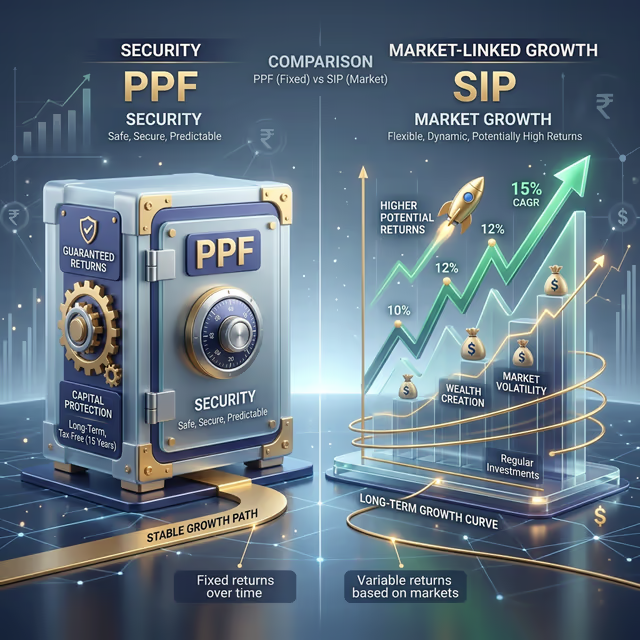
In the world of personal finance in India, two acronyms often stand at the center of the "safety vs. growth" debate: **PPF (Public Provident Fund)** and **SIP (Systematic Investment Plan)**.
While both encourage long-term saving habits, they operate on fundamental different principles. One is a government-backed debt instrument providing guaranteed stability, while the other is a method of investing in market-linked assets for potential outperformance.
1. Public Provident Fund (PPF): The Fortress
PPF is the quintessential "safety first" instrument. It is backed by the Government of India, meaning there is zero sovereign risk. It is particularly valued for its unique tax status.
- Interest Rate: Set by the government quarterly (currently ~7.1% p.a.).
- Tax Status (EEE): Exempt-Exempt-Exempt. Your contribution, the interest earned, and the maturity amount are all entirely tax-free.
- Lock-in: 15 years, with partial withdrawal allowed after year 6.
- Risk: Nil. Capital and interest are fully protected.
2. Systematic Investment Plan (SIP): The Growth Engine
A SIP is not an asset class itself, but a *method* of investing. Typically, SIPs refer to monthly investments in Market-Linked Equity Instruments. This approach thrives on time and consistency.
- Returns: Not fixed. It depends on market performance. Historically, long-term equity performance has often exceeded inflation-adjusted debt returns.
- Liquidity: High. Most equity-linked SIPs (except ELSS) have no lock-in period.
- Risk: High in the short term due to market volatility, but historically moderates over decades.
- Rupee Cost Averaging: SIPs automatically buy more units when prices are low, lowering your average cost.
Comparative Summary
| Feature | PPF | Market-Linked SIP |
|---|---|---|
| Primary Goal | Capital Protection | Wealth Creation |
| Returns | Guaranteed & Stable | Variable & High Potential |
| Risk Level | Zero / Lowest | Moderate to High |
| Maturity Tax | Tax-Free (EEE) | Subject to Capital Gains Tax |
Finding the Balance
Modern financial planning rarely involves choosing one *over* the other. Instead, successful savers often use PPF for their "Debt" portion of the portfolio to provide a stable foundation, and SIPs for their "Equity" portion to combat inflation and build long-term purchasing power.